Francais
 Cart
Cart Quote
Quote300 pharmacies closed in 2025: Understanding the crisis and securing the future
The 2025 figures are in—and they are alarming: 300 pharmacies permanently closed across France. Beyond the raw statistic, this number, published by the FSPF (French Federation of Pharmaceutical Unions), marks a turning point. It is no longer a simple market adjustment, but a structural weakening of the territorial healthcare network. In the face of this erosion, understanding the causes is essential—but identifying survival and growth levers is vital.

With 34 municipalities having lost their last remaining pharmacy last year, this article analyses a phenomenon that is reshaping the profession and outlines concrete strategies to secure the pharmacy of tomorrow.
The anatomy of the crisis: Why now?
While the closure of 300 pharmacies has drawn widespread attention, it merely accelerates a trend that began as early as 2007. However, 2025 acted as a catalyst, bringing several destabilising factors together:
- The demographic and financial wall: Many owners reaching retirement age are unable to find successors, particularly in rural and semi-rural areas. Of the 300 closures, 251 were due to a lack of buyers (the remaining 49 resulted from mergers).
- Economic pressure: Rising operating costs (wages, energy, rents) have collided with increasingly constrained margins, especially on reimbursed medicines.
- The limited impact of support schemes: Contractual aid (up to €20,000 per year) designed to support fragile areas failed to deliver the expected results. By the end of 2025, barely one hundred applications had been approved, hampered by restrictive eligibility criteria and discouraging administrative complexity.
The double penalty: Medical deserts and overload
The closure of a pharmacy creates an immediate shockwave. For patients—often elderly or with limited mobility—it means longer travel distances and the loss of a vital social and healthcare link.
For the remaining pharmacies, it also represents a major operational challenge. They must absorb a sudden increase in patient flow, often without having had time to adjust staffing levels or stock management. The result? Overcrowded counters, declining service quality, and team burnout.
Responding: Optimisation as a shield
In this context, inaction is not an option. At Mdose, we believe that pharmacy sustainability depends on a fundamental rethinking of operational models. While drug pricing is largely beyond control, internal efficiency is not.
Saving time to protect margins
In a strained economic environment, every minute lost to logistics is a minute taken away from patient counselling—and revenue generation.
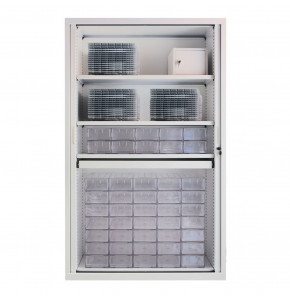
- Smart layout design: A well-designed pharmacy reduces unnecessary movement. Using high-density drawer systems and modular shelving helps concentrate stock close to dispensing areas. Fewer trips to storage rooms mean more time with patients.
- Streamlined patient flows: Redesigning patient pathways to integrate new services (vaccination, rapid tests, medication reviews) without blocking the main counter has become a critical profitability requirement.
Pragmatic digitalisation
Digital investment must not become a gimmick. Interoperability between management software (PMS/LGO), traceability tools, and e-prescriptions should serve one purpose: reducing administrative workload. This “digital hygiene” frees up cognitive capacity for higher-value clinical services.
Towards a new economic model
The survival of pharmacies—especially in rural areas—will increasingly depend on better recognition and remuneration of clinical services. Vaccination, pharmaceutical consultations, and telecare are no longer optional extras, but core revenue drivers.
However, these services require appropriate space and organisation. Pharmacies that fail to adapt their back-office operations and confidentiality areas will mechanically deprive themselves of these growth levers.
A necessary collective mobilisation
The loss of 300 pharmacies in 2025 is a wake-up call for public authorities, who must simplify support schemes and strengthen succession policies. But it is also a call to action for every pharmacy owner.
The pharmacy of tomorrow will be organised, agile, and clinically oriented—or it will not exist. At Mdose, we are convinced that optimising your working environment is the first step towards long-term resilience.