Francais
 Cart
Cart Quote
QuoteTreatment carts and medication cabinets: selection criteria for healthcare teams
In healthcare facilities (nursing homes, clinics, hospitals), treatment carts and medication cabinets are essential to ensuring the safety of the medication management process. Selecting the right equipment requires a precise analysis of usage and operational constraints.

They serve as the organizational backbone of daily nursing procedures and are directly linked to the quality and safety of care. Here is an overview of solutions tailored to each need.
Types of treatment carts
Medication distribution cart
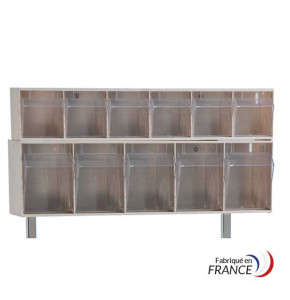
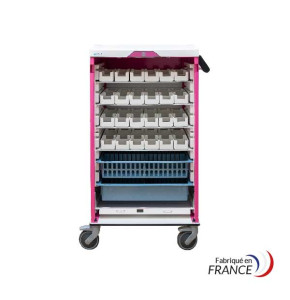
A central piece of equipment during medication rounds, it supports drug dispensing. Modern models feature patient-specific bins, a lockable drawer for controlled substances, and a smooth work surface—essential for optimal disinfection.
View our treatment carts > Medication cart with patient-specific bins
Dressing cart
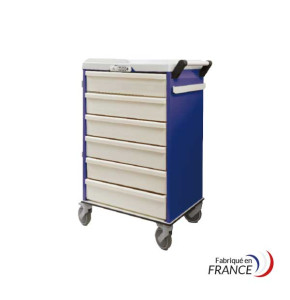
Dedicated to technical care (injections, wound care), it ensures clear organization of consumables. Its design must allow sterile preparation and easy cleaning between patients to prevent healthcare-associated infections.
View our dressing carts > Modular technical care cart
Emergency cart
A highly regulated piece of equipment, it must be immediately identifiable and secured with a tamper-evident seal. Its contents are validated by the responsible physician to ensure maximum responsiveness in case of cardiac arrest.
View our emergency carts > Emergency cart secured with seal
Nursing and hygiene cart
Designed for personal care procedures, these carts reduce unnecessary back-and-forth. They include compartments for clean/soiled linen, holders for gloves and hygiene products, and integrated waste management.
View our hygiene carts > Ergonomic hygiene cart
Key criteria for selecting a treatment cart
- Materials: 304 stainless steel offers maximum durability. ABS or HDPE are preferred for lightweight handling.
- Mobility: 360° swivel castors with brakes are essential for navigating crowded rooms.
- Modularity: Choose configurations that allow adjustment of drawers and accessories depending on the department.
- Security: From key locks to electronic locking systems with traceability for sensitive medications.
- Ergonomics: A worktop height between 90 and 100 cm helps prevent musculoskeletal disorders (MSDs).
Medication cabinets: organization and safety
General medication storage
The central cabinet must be restricted to authorized staff. Its organization (alphabetical or by administration route) should follow strict protocols to eliminate picking errors.
View our storage cabinets > Secure medication cabinet
Medication refrigerator
Thermosensitive products (insulin, vaccines) require strict storage between +2°C and +8°C. A temperature data logger is essential to ensure cold chain compliance.
 Medical refrigerator with temperature traceability
Controlled substances cabinet
Separated from general stock and wall-mounted, it must comply with strict regulations. It should feature dual locking or a secure code system, with rigorous tracking at each shift handover.
View our secure cabinets > Controlled substances safe
Unit-dose (PDA) patient-specific cabinets
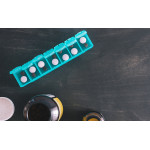
For facilities using unit-dose dispensing, these cabinets store patient-prepared pill organizers. They should be organized by name or room number and located near the nursing station.
View our unit-dose cabinets > Storage cabinet for patient-specific pill organizers
| Cabinet type | Typical contents | Key requirements |
|---|---|---|
| General | General stock | Restricted access, defined protocol |
| Refrigerated | Insulin, vaccines | 2–8°C, data logger |
| Controlled substances | Morphine, Ritalin | Dual lock, strict tracking |
| Unit-dose (PDA) | Patient-specific pill organizers | Identified compartments, proximity to care area |
Maintenance and lifespan
To maximize the lifespan of your equipment, follow these recommendations:
- Use disinfectants compatible with materials (stainless steel, ABS).
- Regularly inspect castors and locking mechanisms.
- Never overload carts beyond their rated capacity.